
STS or SORA? A Guide to C5/C6 and MoC 2511/2512
Published: date by: author
If you’re planning to fly more advanced missions in this specific category—over people, in urban areas, or beyond visual line of sight—you’ll encounter a jungle of acronyms: C5, C6, STS-01, MoC 2511, SORA, geocaging, M2. This guide explains what they mean, but above all how they’re connected and in what order you’ll encounter them. We’ll walk you through the path ahead: from the simple entry point to full freedom as you grow.
Short version: two paths, different levels of maturity
If you’re moving toward more advanced operations, there are essentially two paths to take—and most people follow them in sequence:
- The entry path—standard scenario (STS): If you want to get started quickly, a C5- or C6-classified drone in a standard scenario (STS-01 or STS-02) is often the easiest way to begin. Ready-made rules, no need for your own risk assessment—just a notification to the Swedish Transport Agency.
- The next step – Self-Assessment of Risk (SORA): Once you’ve gotten the hang of things and start running into limitations of what the standard scenarios allow, the next step is usually to write your own SORA, tailored to your specific operational needs. More work, but complete freedom.
The rest of this guide explains the concepts you’ll encounter along the way—in the order they become relevant.
Getting Started: C Classes and Standard Operating Procedures (STS)
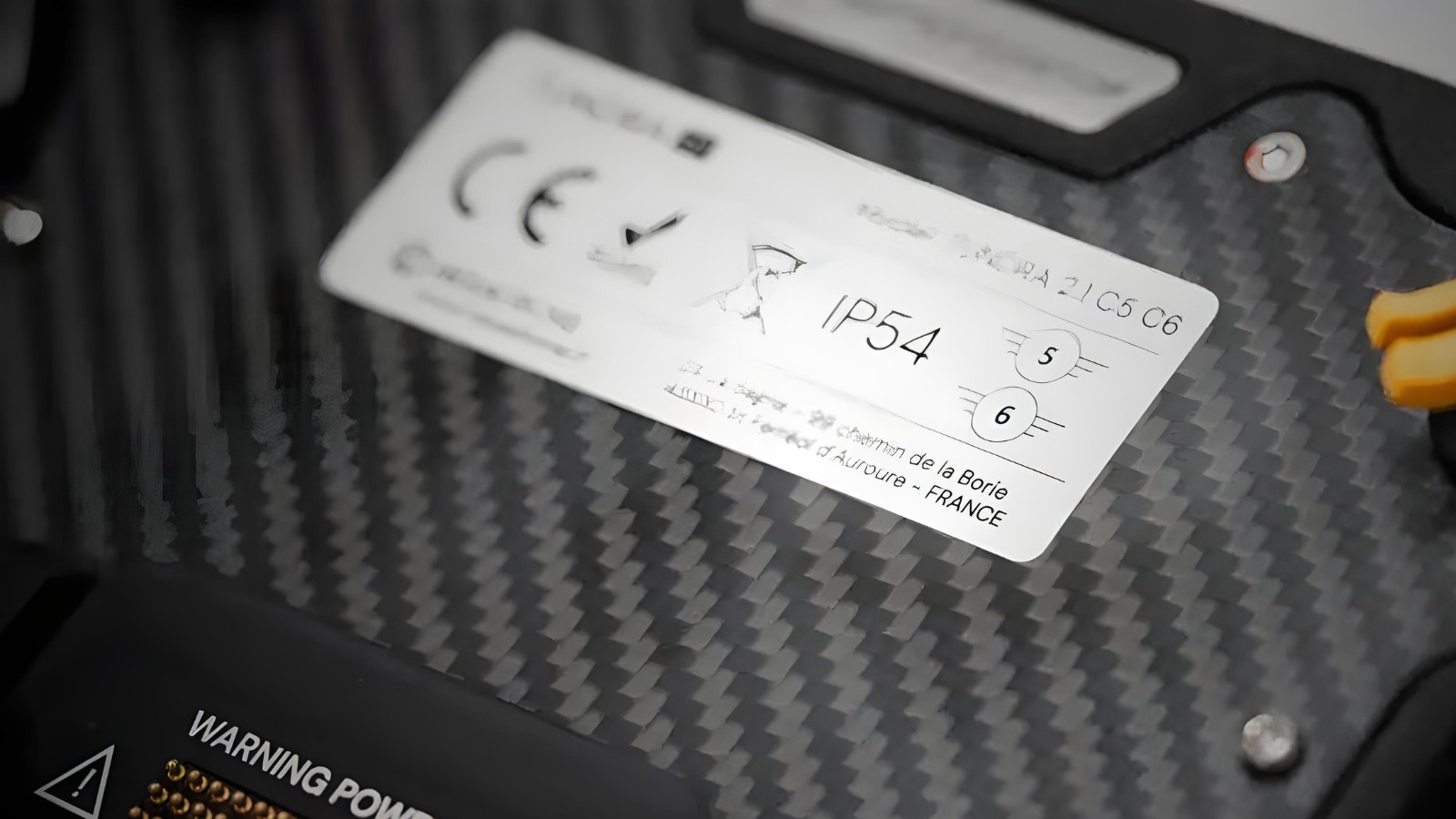
The fastest way to get started is through a standard operating procedure. In that case, you rely on a drone’s C-class designation instead of conducting your own risk assessment. EASA classifies drones from C0 to C6, and two of these are key here:
- C5 → STS-01: visual line-of-sight (VLOS) flight over a controlled ground area in a densely populated environment.
- C6 → STS-02: beyond visual line of sight (BVLOS) flight with airspace observers over a controlled ground area.
If the drone has the correct C-class designation for the scenario you wish to fly, a simple notification (declaration) to the Swedish Transport Agency is sufficient—no separate risk analysis is required. This is why the standard scenarios are the most common path toward more advanced operations. However, a drone does not automatically qualify for these classes; it needs the right safety equipment, such as flight termination and, in some cases, a parachute.
Can the classification be retrofitted?
A common question is whether you can upgrade a drone you already own to a higher class by installing additional equipment. The answer is: it depends.
On some systems, a classification can be achieved by retrofitting an accessory kit—for example, a parachute that elevates the drone to a higher class. On other systems, and for certain classes, the classification is tied to a factory-certified configuration that cannot be retrofitted later. This varies by manufacturer, model, and the specific class in question.
Since this differs from system to system—and regulations are constantly evolving—we recommend that you check exactly what applies to your specific drone before purchasing. We’re happy to help you figure it out.

The Intermediate Step: Predefined Risk Assessments (PDRA)
Between the ready-made standard scenarios and a custom SORA lies the PDRA (Predefined Risk Assessment)—predefined risk assessments developed by EASA for common types of operations. They are of particular interest for one specific reason: some PDRA’s have, in practice, the same operational limitations as the standard scenarios, but rely on Means of Compliance (MoC 2511/2512) rather than a C-class designation.
This means that a PDRA can be a viable option even if the drone is not formally C5- or C6-classified—provided it meets the appropriate Means of Compliance. For an operator with a drone that lacks a C-class designation but has the appropriate safety systems, a PDRA can therefore be the key.
There are several PDRA options to choose from, for different types of operations:
- PDRA-S01 and PDRA-S02: in practice, these reflect the standard scenarios STS-01 and STS-02.
- PDRA-G01, PDRA-G02, and PDRA-G03: for other common types of operations, such as certain BVLOS setups in sparsely populated areas or reserved airspace.
Exactly which PDRA is appropriate depends on the operation—it’s a topic worthy of its own guide. Get in touch if you’d like to know which one matches your missions.
The Way Forward: Self-Assessment (SORA)
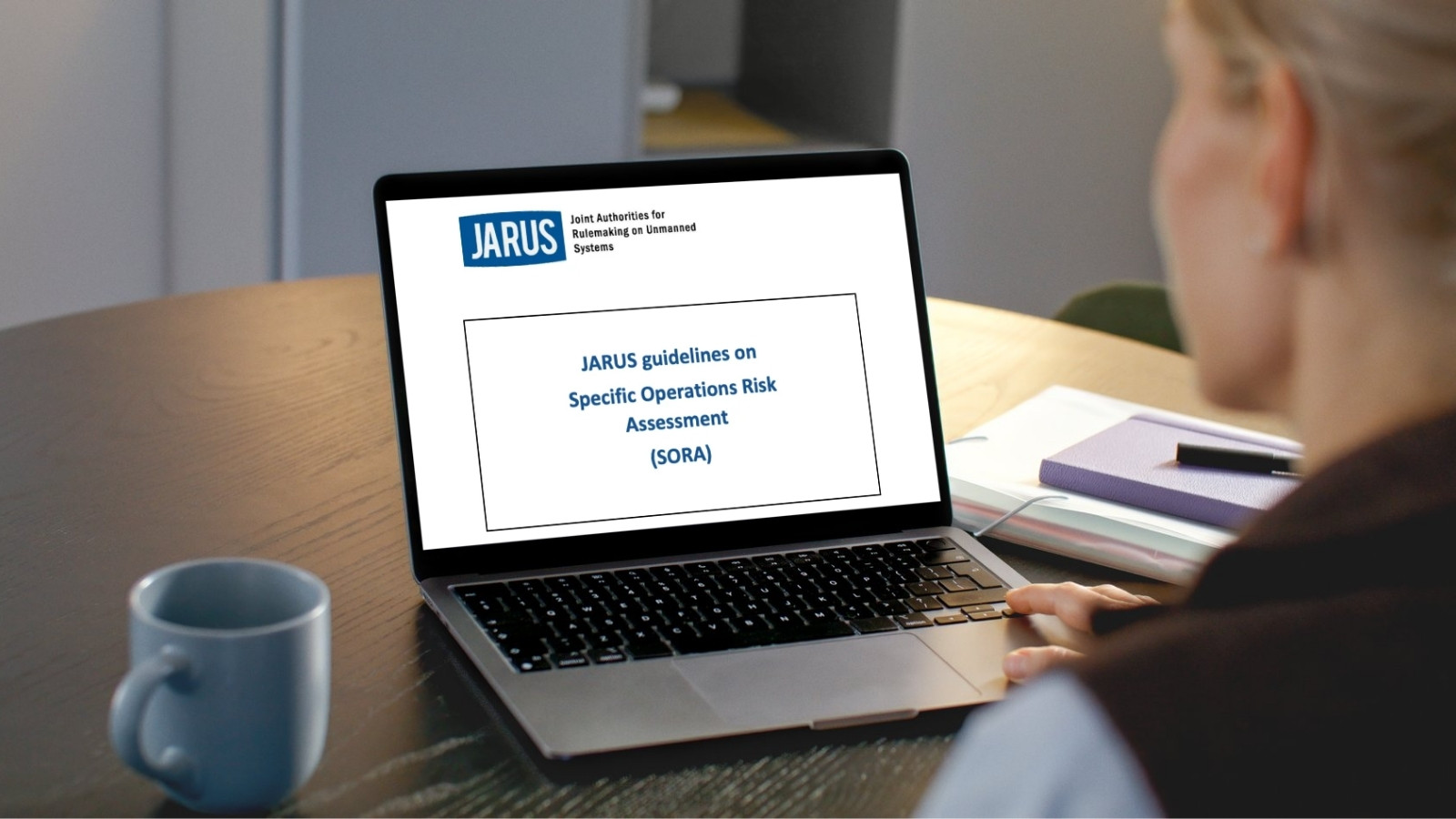
When the standard scenarios and PDRA’s become too restrictive, the next step is a self-assessment (SORA—Specific Operations Risk Assessment)—a comprehensive risk assessment where you tailor the operation to your actual needs. It requires the most work, but also offers the most freedom. The SORA methodology was developed by JARUS (Joint Authorities for Rulemaking on Unmanned Systems) and is being incorporated into EASA’s regulations; STS and PDRA, in turn, are EASA’s own simplifications based on the same logic.
In a SORA, you calculate the operation’s risk yourself. This is done in three steps:
- GRC (Ground Risk Class): ground risk—how dangerous it is for people on the ground if the drone crashes.
- ARC (Air Risk Class): air risk—the risk of colliding with other aircraft.
- SAIL (Specific Assurance and Integrity Level): the result when ground and air risks are weighted together. SAIL indicates how robust the operation must be—the higher the SAIL, the stricter the requirements for equipment, procedures, and documentation.
The whole point of risk-reducing measures (mitigations) is to lower the GRC and ARC—and thus the SAIL—to a level the authority can accept. This is where the concepts covered in the rest of this guide—containment, flight termination, and the M2 mitigation of the parachute—become your tools.
Containment: keeping the drone where it’s supposed to be
A recurring requirement is that the drone must be kept within a defined airspace and be able to abort the flight if it leaves that area. This is called containment, and it is based on first defining the volumes within which the operation is to take place:
- Flight Geography (FG): the volume where the mission is planned and flown.
- Contingency volume (CV): a buffer around the flight geography, where the drone is still under control but outside the planned flight path.
- Operational volume (OV): the flight geography and contingency volume combined—the outer boundary that the drone must not leave.
Outside the operational volume lies a ground risk buffer—a safety margin on the ground that is included in the risk assessment. Once the volumes are defined, two things are needed to actually keep the drone within them: a system that intervenes when a boundary is crossed, and a system that monitors the boundaries. The first is FTS; the second is geocaging.
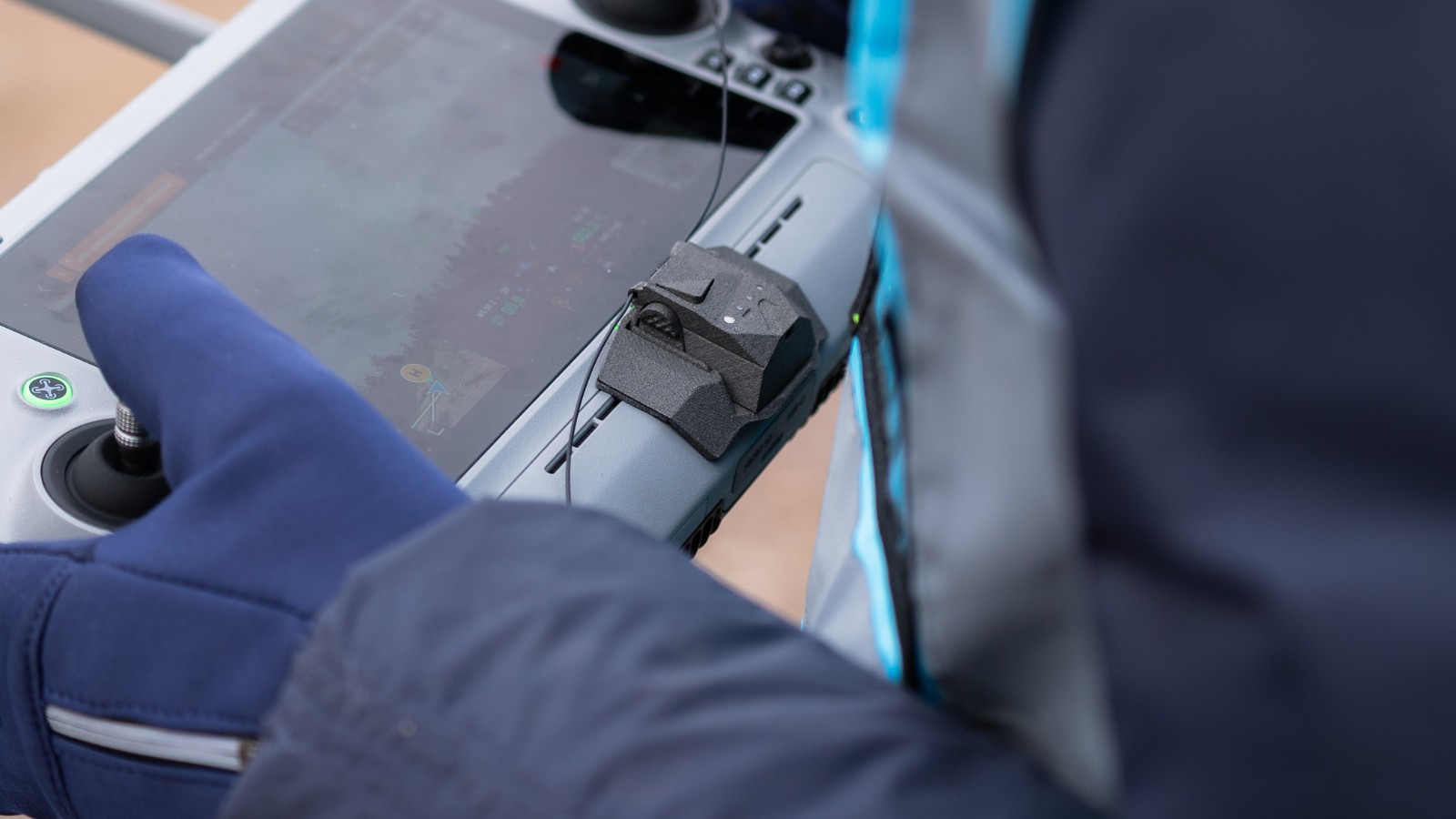 Manual activation of FTS using a remote control (Dronavia)
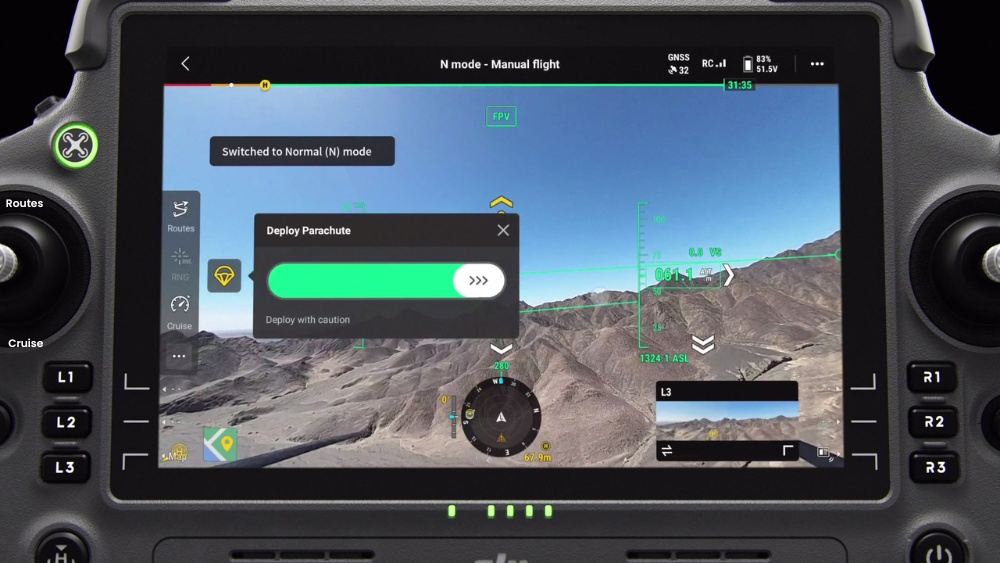
Manual activation of the FTS using the app (DJI AP100)
FTS: The Core of the Safety System
FTS (Flight Termination System) is the heart of a modern parachute system—the feature that terminates the flight in a controlled manner when something goes seriously wrong. When triggered, the motors shut down and the parachute deploys, causing the drone to descend toward the ground rather than crash. It is the FTS that allows the drone to be stopped before it enters an area with a higher risk than where you are authorized to operate—and that is why it is a key requirement for most advanced operations.
FTS can be activated in several ways: automatically in response to abnormal movements or speeds, manually by the pilot—or by its closest assistant, geocaging. Manual triggering can be done with a separate remote (such as Dronavia’s in the image above) or via a command in the app (such as the DJI AP100 in the image above).
Geocaging: FTS’s right-hand man
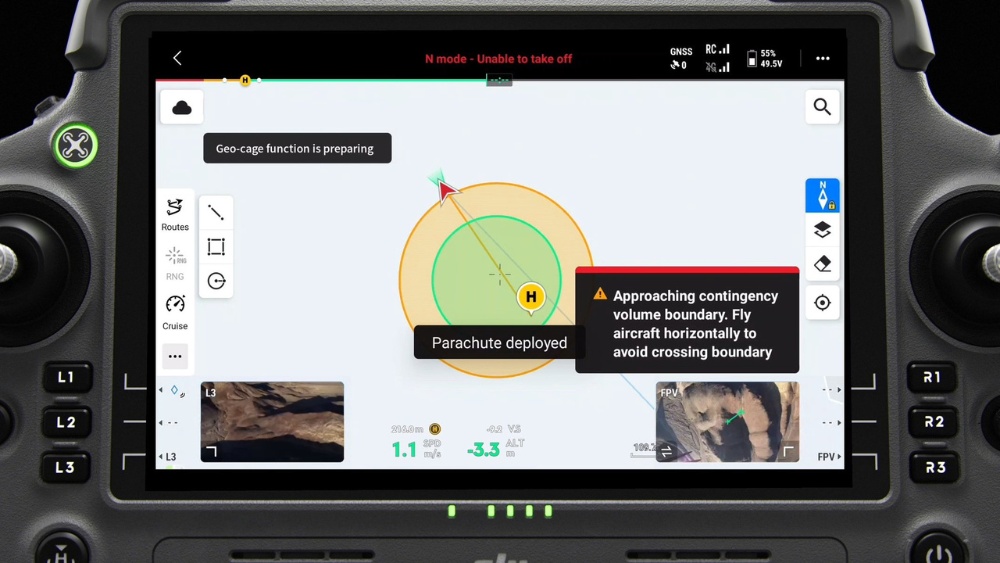
If FTS is the safety system’s last resort, geocaging is the early warning that, ideally, should ensure it never comes to that. Geocaging monitors the drone’s location relative to the permitted airspace boundaries and sounds an alarm well in advance. In modern systems, you define the flight area and the safety zone directly in the pilot app, with visual feedback on the screen, and the boundaries are continuously monitored during flight:
- Within the flight area, you fly freely.
- When the drone approaches the boundary of the contingency zone, it automatically slows down and clearly alerts the pilot, allowing time to steer back.
- If the drone leaves the entire operational zone despite the warnings, geocaging triggers the FTS, which activates automatically.
The point of geocaging is, therefore, that FTS should ideally not need to be activated—the advance warnings should be sufficient. Geocaging is rarely highlighted in marketing, but it’s the loyal assistant that does the heavy lifting so that FTS only needs to intervene as a very last resort.
Enhanced Containment and MoC 2511
In more demanding operations—for example, via PDRA or SORA—it is not enough to simply state that the drone remains within the area. You must prove it to a higher standard. This is called Enhanced Containment, and it is applied, for example, when adjacent areas contain crowds, when the adjacent airspace poses a high air risk (ARC-d), or when the operation takes place in a populated area.
The core requirements are that the probability of the drone leaving the operational volume must be very low, and that no single failure may cause it to leave the ground risk buffer. MoC 2511 (Means of Compliance Light-UAS.2511) is the standard that demonstrates a system’s compliance with Enhanced Containment. It is therefore a matter of keeping the drone in place and being able to terminate the flight—and it is precisely FTS and geocaging together that are the mechanisms behind this.
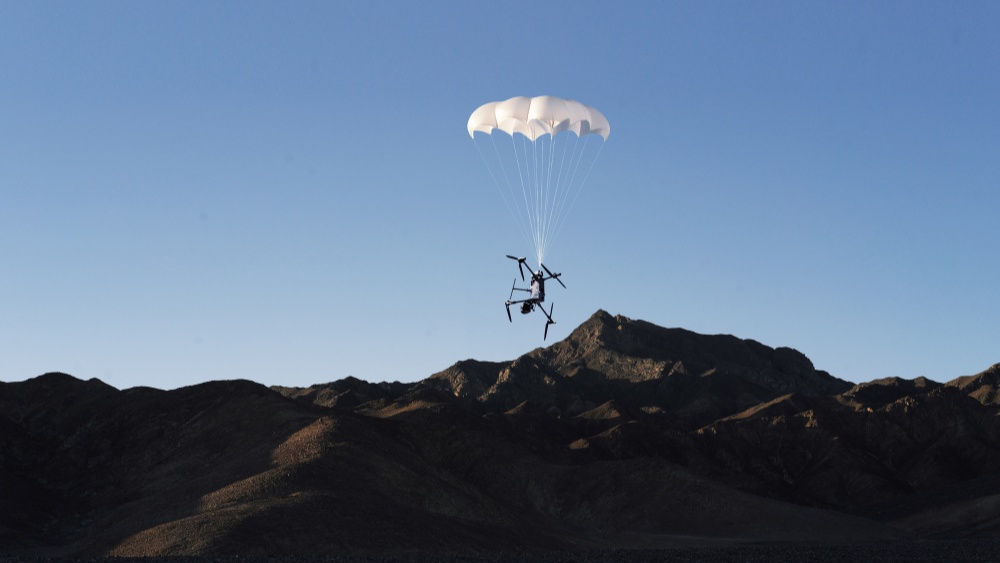
M2 Mitigation and MoC 2512: When Things Go Wrong Anyway
Enhanced Containment is about preventing the drone from ending up where it shouldn’t. But what happens if it crashes anyway? This is where M2 mitigation comes in—EASA’s term for measures that reduce the impact of a ground strike, i.e., how severe the damage will be when the drone hits the ground.
A parachute is the clearest example: it reduces the impact speed and thus the impact energy. EASA even uses the parachute as its own example of M2. Parachute systems are often referred to in the industry as PRS (Parachute Recovery System), and MoC 2512 (Light-UAS.2512) is the standard that demonstrates the system’s compliance with M2 mitigation.
How it all fits together
If we pull all the threads together, it comes down to two different ways of managing risk—prevention and mitigation:
- Prevention (containment): Geocaging defines the volumes; FTS terminates operations if they are exceeded. MoC 2511 demonstrates that it meets the requirements. This is the core of C6/STS-02 and a prerequisite for most BVLOS operations.
- Mitigation (M2): the parachute reduces the damage if a crash does occur. MoC 2512 demonstrates that it meets the requirements. This is particularly relevant for operations with high ground risk.
Note that a parachute is not in itself a requirement for C6/STS-02—there, flight termination and a defined operational volume are the primary considerations. The parachute becomes crucial in other contexts, such as SORA operations where ground risk needs to be reduced. A system that complies with both MoC 2511 and MoC 2512 gives the operator maximum flexibility: the same hardware works regardless of whether the landing is in STS, PDRA, or SORA.
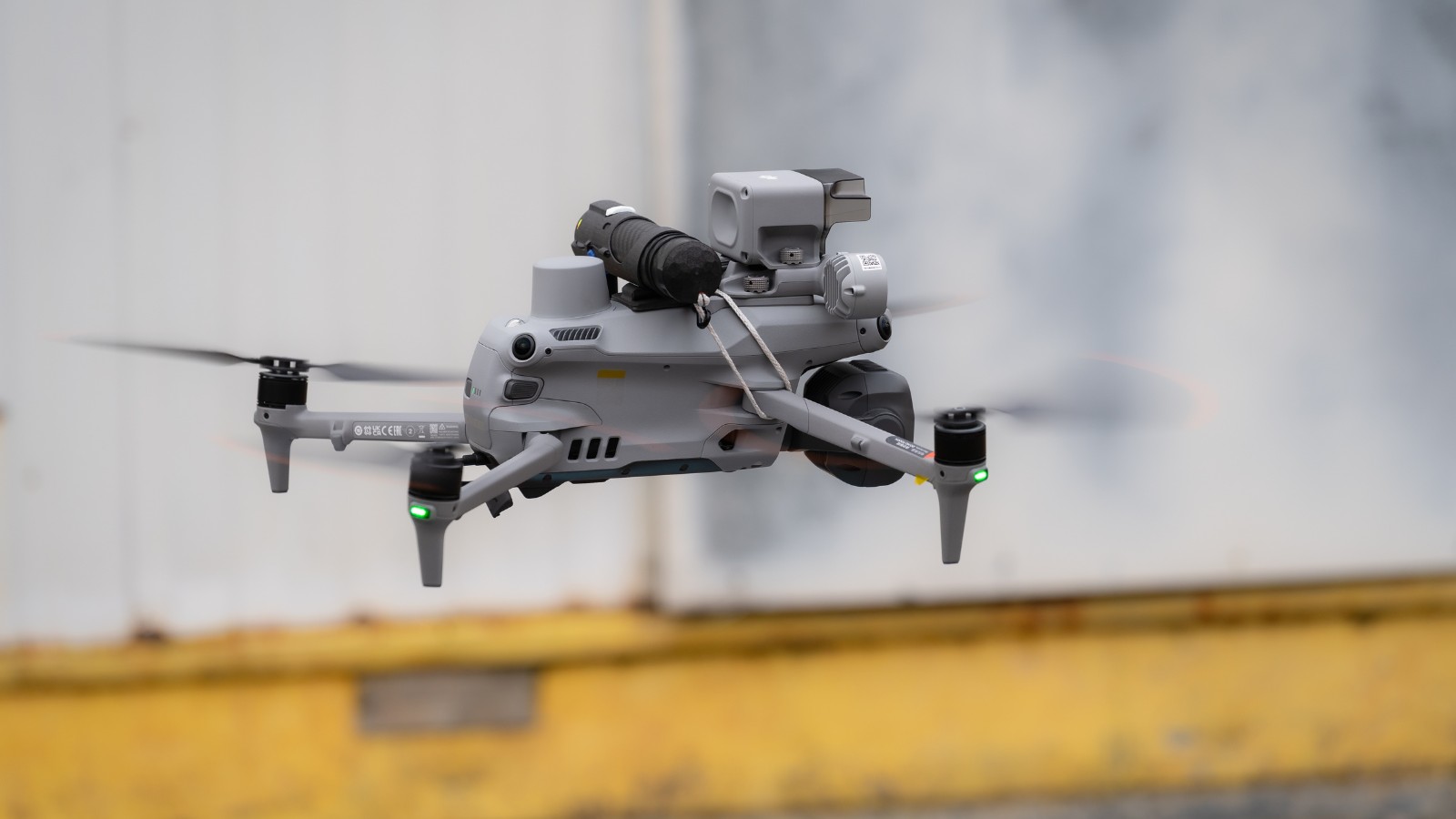
What systems are available on the market?
An increasing number of manufacturers are offering integrated parachute and flight termination systems that meet these requirements. Some examples:
- DJI AP100 (for Matrice 400): DJI Enterprise’s first parachute system with an integrated FTS. EU type-approved and declared in accordance with both MoC 2511 and MoC 2512, with geocaging configured directly in DJI Pilot 2. Can remain mounted in the carrying case and be triggered via the pilot app without a separate remote control.
- Hexadrone Tundra 2.1: a modular platform that has achieved C5/C6 coverage with corresponding MoC declarations.
- Dronavia systems: third-party parachute/FTS solutions that can be integrated onto various platforms, including certain DJI models.
The systems vary in price, ease of use, and how well they are integrated into the drone—ranging from standalone solutions with external equipment to fully integrated systems where the parachute, FTS, and geocaging are controlled from the same interface.
Do you need help choosing a path?
Most people start with a standard scenario and a C5- or C6-classified drone—that’s the fastest route to more advanced operations. As you grow and reach the limits of what the standard scenarios allow, the next step is usually your own SORA, built around your actual needs. That’s when MoC 2511 and MoC 2512 become crucial, as they validate the risk mitigations your SORA is based on.
Wherever you are on that journey, we at Scandinavian Drone are here to help you move forward—from choosing the right classification and standard scenario to get started, to a complete SORA once you’ve outgrown the templates. Get in touch, and we’ll figure out the next steps together.
This article is a simplified overview intended to explain the concepts in an accessible way. It should not be considered complete or legally binding. The regulations governing drone operations are constantly evolving, and it is always the operator’s responsibility to familiarize themselves with the applicable rules and their updates. Always check EASA’s and the Swedish Transport Agency’s current publications before conducting an operation.